Showing posts with label villain. Show all posts

Wednesday, November 4, 2015

An Amusing Villain to Read About in Designing America (Just Not in the History Books)

Normally I write both week’s Muses and Musings blogposts on Sunday, but it’s now 8:11 in the morning on Wednesday, and I’m just starting today’s.

It’s been one of those weeks.

Not all in bad ways, admittedly. I mean, Sunday’s NaNoWriMo kick-off had me writing 10,000 words in a day. And between Monday and Tuesday, I wrote another 10,000 despite alleged bedbugs and a hectic work day, the combination of which had me sobbing like a 14-year-old on my mother for the first twenty minutes of my drive down to last night’s NaNoWriMo write-in.

Not fun, right?

But what is fun is my one villain. I hate to say that, because this isn’t a villain of my own making. Lieutenant-Colonel Banastre Tarleton was a real person and a real jerk according to American history books. You know The Patriot starring Mel Gibson? The antagonist in it... Colonel William Tavington, who locks civilians in a barn and then burns it down?
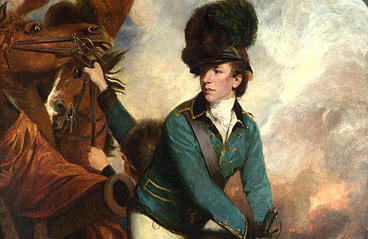
That wretched fictional character was based on the wretched real-life character of Tarleton. And while I didn’t come across any actual accounts of him burning anyone to death, what I did read was disturbing enough. Always a brash young man (who, it turns out, got a brief mention in Maiden America, though not by name), he was a skilled cavalryman and commander who didn’t think much of the people he was sent to subdue.

Hence the reason why, after his victory at the Battle of Waxhaws, South Carolina, he ordered his men to go through the list of surrendered American soldiers and bayonet them to death.

As for those men, it can easily be argued they were even worse. Here’s a history-filled excerpt from Designing America’s (and Maiden America’s) heroine Abigail Carpenter’s perspective:

The clear leader of the sizable Calvary reins in his brown horse, leaving the mount champing at the bit to get back to his canter. It’s a magnificent beast with its own mind, I can tell, so it says a lot about its seated master that it only tosses its head and lets out a whinny before quieting down altogether.
I know who that master is before he introduces himself. His immaculate attire speaks volumes by itself, as does the appearance of his men. They are all well-clothed and well-fed. In a group that size, that means they won’t be Americans.
I think the man himself in his mid-twenties, and he is very attractive to look at with his red hair and broad shoulders covered by a green coat with gold trimmings and buttons, and white breeches beneath. His hat is black and billed with a very large black plume atop it, and his boots are black up until his mid-calf and then brown the rest of the way to his knees. Moreover, along with the two buckled belts slung over each shoulder, he is fitted with a saber and a long musket.
His name is Lieutenant-Colonel Banastre Tarleton, and he’s a monster, no matter how pretty and proud he sits there before me. It is his men who have been accused of mutilating and murdering pregnant women. It was also two of his men who were hung back in May on Cornwallis’ orders, not their direct commander’s, on charges of robbery and rape.
I imagine not nearly enough of them swung from the gallows that day.

So again, I’m not proud of myself for smirking over this character. In my defense, he’s been nothing but nice to Abigail, since he’s trying to prove himself a respectable gentleman instead of the monster she very obviously regards him as during their entire first day of acquaintanceship.

That alone wouldn’t make me enjoy him (notice I’m staying far away from the word “like”). It’s the fact that, in trying to stay true to the history books, where even some of his fellow British officers described him as an arrogant little brat, I’ve turned Tarleton into just that… an arrogant little brat, who will roll his eyes in polite company when polite company turns tedious, and make the kind of comments you really want to say to irritating individuals but can’t because you’re too well-mannered.

It’s a bit hard not to snort in amusement over that kind of villain. I dare you not to do the same when I’m done writing Designing America.

Wednesday, October 7, 2015

Gillian Bronte Adams’ “Villainy 101: How to Trap a Hero” Is Creative Genius!

I have to give major props to two creative people:

·         Mia Zachary, who found the awesome picture below and sent it to me on Pinterest
·         Gillian Bronte Adams, who posted the awesome picture in the first place

I’m friends with Mia and know her creative tenacity, so it doesn’t surprise me she was able to find such a creativity-inducing image. But after following that image back to its original source at GillianBronteAdams.com, I also have to give props to Ms. Adams.

Anyone who’s struggling to trap their hero for climatic effect – or just because it’s fun to be a jerk – should check this blog post out. In fact, you should read it regardless. It’s that good!

The memo stands out in all the right ways. “From the Academy of Ultimate Villainy: Today’s Lesson: How To Trap A Hero.” Never mind that the colons are a little repetitive and the “to” should be lowercased considering the previous preposition. Who cares about grammar when there’s apparently a school for scoundrels.

Mind blown!

This revelation begs to be explored further. Do these educational institutes of evil learning have university-sized classrooms where trolls take notes and bullies search for victims to snatch them from? Does the insufferable blond girl lick her glossy lips in anticipation of how to ensnare her own nemesis, while the brunette vampire beside her tries to pay attention to the lecture instead of turning her teeth on her classmate?

Those thirteen words beg a story, if not an entire series. And Adams rises to that challenge with a breakdown of “Dr. Sinestra’s lecture” as recorded by some spy at the dastardly school.

Thanks to that correspondence, we learn that there are three main kinds of heroes:

·         The Romantic
·         The Idealistic
·         The Clever

And trapping them is as easy as one-two-three once it’s established which group they fall into.

As Dr. Sinestra says, “The number one rule of hero trapping is to offer the hero something he cannot resist. Every hero has a weak spot” to exploit. “Offer the thing he most desires, and then snatch it from his grasp at the last moment” to “leave him in utter despair.”

This Dr. Sinestra is one wise villain. No wonder he got the position at the Academy!

At the risk of encouraging such literary nastiness, I’m going to point out that writers could learn a thing or two from him.

Wednesday, March 4, 2015

Creating a Villain. Or Two. Or Three.

In Faerietales Books 1 and 2, I have three main villains… Which, come to think of it, is rather mean of me. Pitting Sabrina against any one of them is bad enough, but all three? That’s definitely an unfair fight, even with her superior faerie strength and sense of snark (i.e. sarcasm).

Oh well. The stories are already written, and I ain’t changin’ them. So she’ll just have to deal.

And yes, if I was Sabrina (which I’m not, since I have short brown curly hair and brown eyes, not straight yellowish hair and green eyes. Such a big difference), I’d hate me.

But moving on to how I created Mr. Smiley, Dr. Morrison and Dr. Stewart.

Believe it or not, I didn’t base them on anyone in particular. Not at first anyway. Stewart did take on a few characteristics of a former creepy coworker of mine, but that was in much later drafts.

The truth is that all three characters are fairly “typical” villains, when you think about it. There’s nothing redeeming about any of them, and unless you’re way too kindhearted for your own good (*cough* *cough* *Mom*), readers are supposed to want them dead. That’s how I intended it.

I could have gone into depth about their good qualities, since I do believe everyone has at least one. I can’t think of a single person who is wholly evil, though some individuals certainly come close.

Simply put though, I didn’t want to. I wanted to show how ugly bigotry (Mr. Smiley), egotism (Dr. Stewart) and unscrupulous pursuits of science (Dr. Morrison) can get.

Warning: Here’s where I might get a bit preachy.

Most of us know that judging people by generalized category is unfair and hurtful. The same goes for being an arrogant little prat, placing our inclinations above everyone else all the time.

But idolizing intellectual studies can be just as dangerous. How so? Try talking to a pretentious English major and you’ll understand pretty darn quickly.

Ok, that’d be more like chit-chatting with Stewart, not Morrison. So check out the Nazis instead.

It’s a documented fact that the Nazis were inspired by Darwinian science. They used it to justify the designation of “sub-humans” suitable for lab rat-status. And the experiments they consequently ran on twins, dwarfs and other individuals with genetic anomalies were revolting.

(If you ever want nightmares, do a study on Nazi doc Josef Mengele. Ugh!)

That kind of intellectual superiority, which doesn’t always show itself so vividly, bugs the heck out of me. Hence the reason why I probably portrayed certain villains as harshly as I did.

Then again, come to think of it, maybe Morrison, et al were inspired by some of my college profs... Hmm.